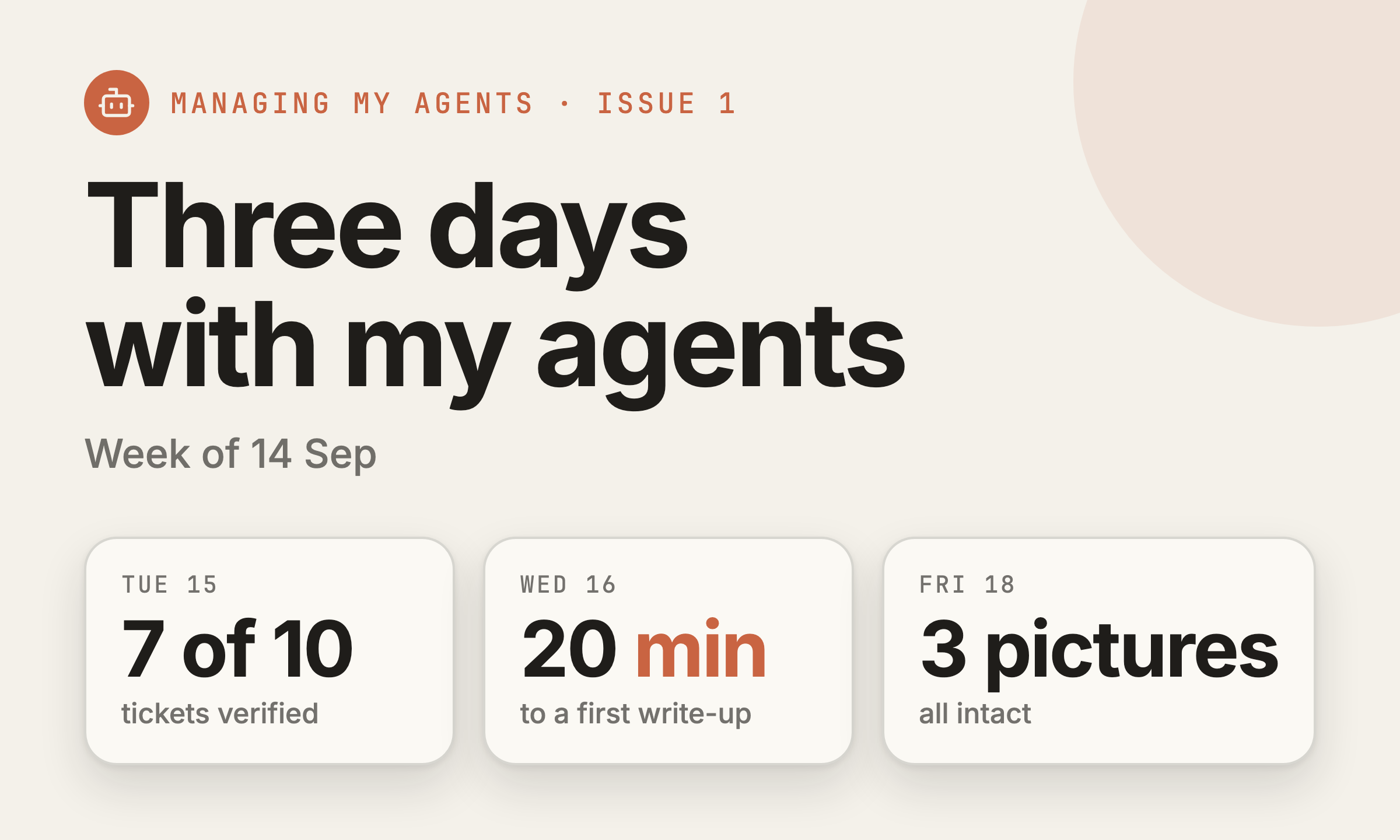
Three days from the week of 14 Sep, with Sally, the orchestrator agent that runs the other agents in my setup.
For a few months now, most of my product work has run through a small set of AI agents I set up for myself.
In September, about three-quarters of what I produced went through them, and I steer nearly all of it.
So I’m writing it down as it happened, one working day at a time, and once a week I’ll put a few of those days together here.
Some days are good, a lot are ordinary, and some are days I had to correct them.
Along the way I’ll share the small lessons, like the behavior I want from an agent, the questions I’d ask it, and what to do when something goes wrong.
Every entry is a real day, with its date.
It was the weekly release cut.
I gave Sally one line asking her to set me up for the release, and she worked out the release name and the start and release dates and handed me the values.
I created the release myself and told her “Done,” and my agents tagged all ten ready tickets into it, none skipped.
The QA I did myself, because that’s the judgment part.
After each ticket I sent the link and one sentence, and every time an agent added a comment recording my verdict, moved the ticket to ready for release and kept the count on my daily note.
My most-repeated sentence was “The functionality and the UX are working as expected.”
Seven times, word for word.
Seven tickets that afternoon, three of ten left, while I steered two other sessions in the same hours.
Analyses like this needed support from data engineering, data analysts or data scientists.
A stakeholder had a coverage question, how much of our data has the three things we need, drawn as one Venn diagram.
I told Sally to reason hard and grill me on scope before she ran anything.
She did.
She told me my database access hadn’t been granted.
I pushed back, she checked, and she said “my claim was narrower than I stated it,” because the grant existed but pointed at the wrong names.
Once the access was re-granted, her write-up was there about twenty minutes later.
Along the way she corrected her own numbers out loud more than once, including a bug in her own query that had made every field look complete.
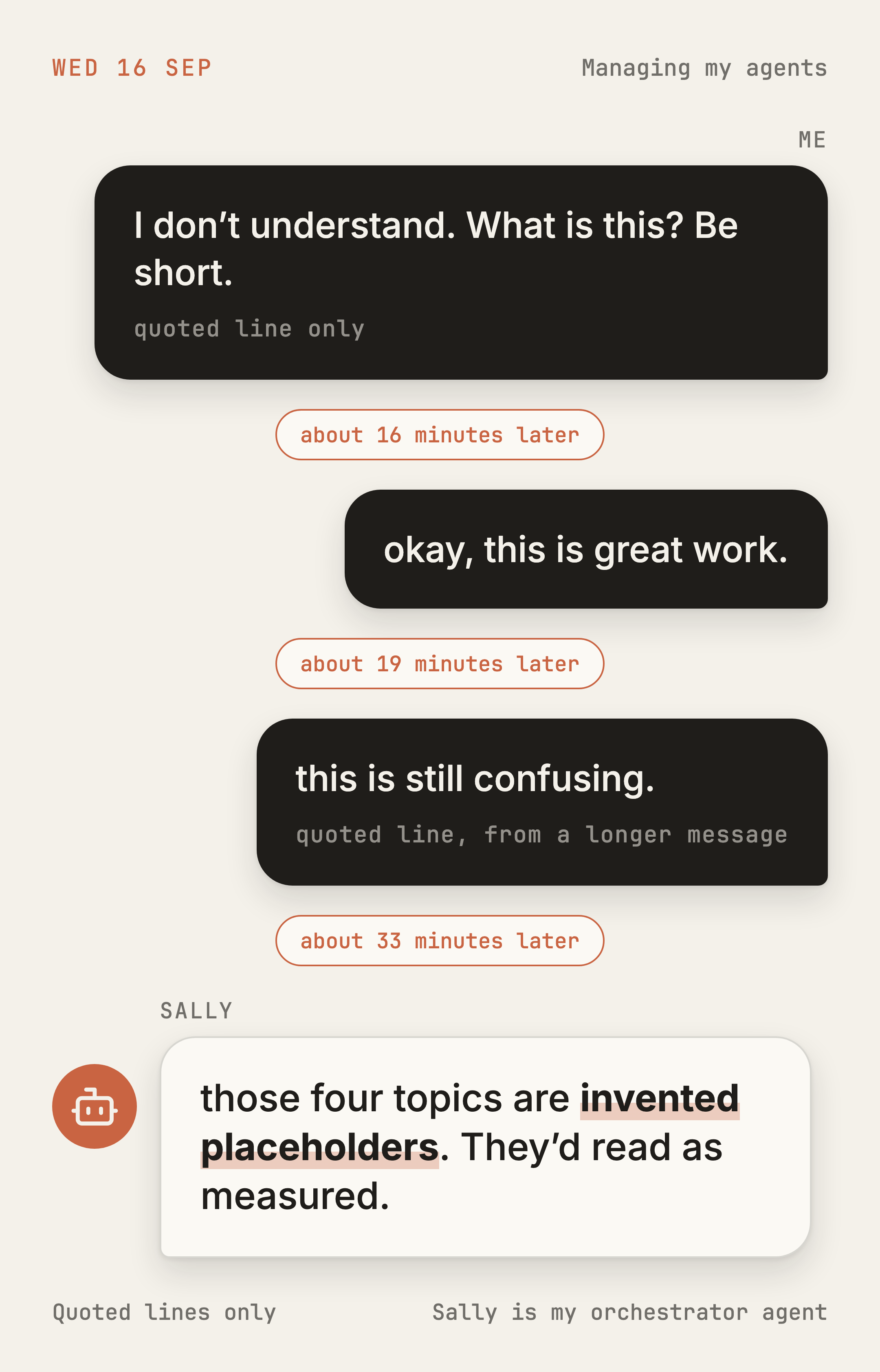
My first reply to the write-up was “I don’t understand. What is this? Be short.”
I asked her to put the statistics in plain business language, she rewrote them, and I told her “okay, this is great work.”
The diagram took six versions in under an hour, and my contribution to a couple of them was some version of “this is still confusing.”
One panel showed four example entries for a typical company, and I asked whether those were really the most common ones, because my stakeholder was going to ask me that.
They were placeholders, and Sally said so straight away: “those four topics are invented placeholders. They’d read as measured.”
Getting the real ones moved the headline number too.
I think that’s kind of the job now, right?
The agents do the querying and the drawing, and I ask the question my stakeholder is going to ask before the work reaches them.
My agents offered to add one line to a release note I had already published, and I said yes.
Seconds later I stopped them, because I had made edits to that page by hand, and I wrote, “Make sure you read them.”
They looked.
My edits were three screenshots, and the text version of the page that they read first doesn’t show images at all, so updating from it would have wiped all three.
They updated the page another way, and the line went in with all three screenshots intact.
I’d say anything changed by hand should be mentioned before the agents touch it again, since they may not even see it.
And for the record, my “manual edits” were three pictures.